
By Jamie Dobson, author of Visionaries, Rebels and Machines
The term Enshittification was coined by technology writer Cory Doctorow to describe the systematic degradation of online services that once made our lives better. If you’ve ever wondered why Facebook feels more like an advertising hellscape than a social network, why your carefully curated LinkedIn posts disappear into an algorithmic void, or why Netflix seems determined to stretch a single series of Stranger Things across multiple months, then you’ve experienced enshittification firsthand.
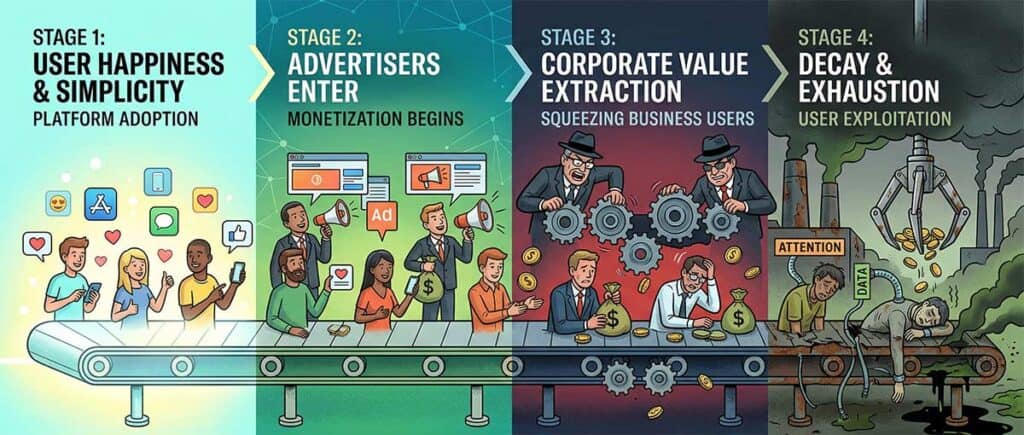
Image: AI generated
It’s not just your imagination. These platforms really are getting worse. And there’s a depressingly predictable pattern to how it happens.
The Four Stages of Platform Decay
Enshittification follows a clear trajectory. Platforms don’t start awful – quite the opposite. They begin by being genuinely useful, even delightful. But their descent into mediocrity follows four distinct stages.
Stage One: Be good to users. The platform starts small, making something users genuinely want.
Stage Two: Be good to business users. As the user base grows, the platform needs revenue. They start catering to advertisers and business users, but they’re careful not to alienate the core audience.
Stage Three: Extract value from business users. The platform goes public or takes on serious investment. Now it needs growth, profit, and ever-increasing returns. The company starts squeezing business users.
Stage Four: Extract value from everyone. This is where platforms become completely enshittified. They’ve reached market saturation. The only way to increase profits is to make things worse for everyone. Users get bombarded with ads, spam, and algorithmic manipulation. Business users pay more for worse service.
And this isn’t just a technology story – it mirrors the broader growth trajectory of companies in our current economic system. Start small and user-focused, scale rapidly, monetize aggressively, then squeeze every penny out of the corpse until it stops twitching.
Beyond Social Media: The virus spreads
Social media is where you’ll find the vanguards of enshittification, but it’s spreading across every digital service.
Remember when the deal with streaming services was pay one monthly fee, watch everything, no ads. If you want that service these days, you need to pay a higher fee.
We’ve recreated cable television, except that it is more expensive and more fragmented.
Dating apps exemplify how to speed-run enshittification. Tinder started as a simple, free way to meet people. But actual, long-lasting relationships reduce its user base and being happy doesn’t bring in revenue. Now it’s a carefully engineered frustration machine where the algorithm deliberately hides your matches unless you pay for premium features.
E-commerce platforms have soured online shopping. Amazon’s search function now serves you sponsored results over cheaper, higher-quality items. While eBay has become so cluttered with promoted listings that finding genuine bargains requires archaeological skills.
The economics of inevitable decay
This is a predictable consequence of how we’ve structured our economy around infinite growth and shareholder returns. When platforms start out, they’re focused on creating value for users because they need users to exist. But once they’ve reached market saturation and taken on shareholders, the focus shifts to extracting value from users. There’s literally nowhere else for growth to come from.
The stock market demands quarterly growth forever, which is mathematically impossible on a finite planet with finite users. This is especially true with rapidly growing technology companies ─ it’s relatively easy to achieve 100% growth by increasing your user base from one million to two, but much harder to double from three to six billion.
Eventually, every platform reaches the point where the only way to increase profits is to make the service worse while charging more for it. They’ve saturated their market, eliminated their competition, and locked in their users. The next logical step is to harvest the trapped audience like battery farmed chickens.
This is capitalism eating its own children. Financial incentives birth successful platforms but then demand so much growth that they buckle and die. Capital flees the sinking ship and finds new projects to drive into the ground.
When even Capitalism says “This is too much”
The enshittification model is fundamentally unsustainable. You can’t endlessly extract value from users without eventually destroying the thing that made them valuable in the first place. When users finally revolt—and they will—these platforms will face catastrophic decline. Their business models depend on network effects, and network effects work in reverse just as powerfully as they work forward.
Even from a purely capitalist perspective, this approach is self-defeating. These companies are strip-mining their own future. They’re trading long-term sustainability for short-term profit extraction, which is exactly the kind of behavior that destroys markets and creates opportunities for disruptors.
Some companies have recognized this. Google, for all its flaws, has been notably slower to enshittify its core products compared to Facebook or Twitter. Their leadership has remained more product-minded, understanding that their dominance depends on actually being useful rather than simply being unavoidable. They’re still addicted to growth, but they’ve been more careful about killing the goose that lays their golden eggs.
Even eBay, that monument to early 2000s web design, has resisted major changes partly because users were familiar with how everything worked. Sometimes what looks like technological stagnation is actually resistance to enshittification.
The counterexamples give us hope
Not every digital platform follows this path to hell. Some have found ways to resist enshittification, and their success points toward possible solutions.
Wikipedia remains one of the internet’s greatest success stories precisely because it was structured from the beginning to resist commercial pressure. It’s a non-profit organization run by volunteers, funded by donations rather than advertising or investment capital. Because Wikipedia doesn’t need to generate ever-increasing returns for shareholders, it can focus on serving users rather than extracting value from them. In fact, the more users it serves, the better it becomes, as more people contribute knowledge and corrections.
Open-source projects like Linux follow a similar pattern. They’re not trying to satisfy shareholders – they’re trying to satisfy users. The more people use Linux, the more developers contribute to improving it. Competition happens through diversity of distributions and approaches, not through corporate consolidation and rent-seeking. These projects get better over time rather than worse because they’re structured around collaboration rather than extraction.
The key insight here is structural: these platforms avoid enshittification because they don’t have the economic incentives that drive it. They’re not trying to maximize quarterly growth or satisfy venture capitalists. They’re trying to solve problems and serve communities.
Challenger banks like Monzo, Starling, and Revolut have disrupted the traditional banking sector by providing better service in a sector that was stagnant and resistant to change. They’re easier to use and more accessible, adding features valued by customers rather than simply trying to increase profit.
But here’s the crucial question: will they maintain these advantages as they mature and face pressure for greater profitability? Both Monzo and Starling Bank are reported to be preparing for IPOs this year which may lead to the same pressure for infinite growth. The jury is still out, but their early success demonstrates that users will flock to platforms that prioritize their needs over extraction.
Vinted is currently providing an interesting case study. This second-hand clothing platform is competing directly with eBay by eliminating seller fees entirely (something eBay is now copying). But they’ve reached market saturation in their core regions, and investors will eventually demand higher returns. Will they resist the temptation to enshittify, or will they follow the familiar pattern of extracting value once users are locked in?
The regulatory solutions that actually worked
Cory Doctorow argues that we already know how to fix enshittification because we’ve had the tools before. For decades, four specific forces kept companies from becoming extractive rent-seekers: competition, regulation, labor power, and interoperability. The problem isn’t that we don’t know what works, it’s that these forces have been systematically dismantled over the past forty years.
When Alexander Graham Bell invented the telephone, the early industry was a complete mess. Different telephone companies couldn’t connect to each other’s networks. You might need three different phones just to call all your contacts. The system was fragmented, expensive, and barely functional.
The solution wasn’t to let market forces sort it out – it was regulation. Governments imposed strict rules about service availability, profitability margins, and reinvestment requirements. Phone companies became regulated utilities, required to provide universal service and prohibited from extracting excessive profits from their monopoly positions.
The same approach worked for electricity, water, and other natural monopolies. These services are too important to leave to pure market dynamics, and the economics of network effects make competition impractical beyond a certain point.
Crucially, we need to restore interoperability – the right to modify, hack, and improve the digital tools we use. Twenty years of expanding intellectual property law has made it illegal to fix defective products or create competing services. We can’t even install generic ink cartridges in our printers without potentially breaking the law. Restoring “adversarial interoperability” would let users escape walled gardens and create alternatives when platforms turn hostile.
The real power belongs to users
Here’s the thing about enshittified platforms: they’re vulnerable. Their business models depend entirely on user engagement, and users can choose to disengage. It’s not the creators of technology who determine its destiny – it’s the users. It’s determined by the people who set policies, vote in elections, run businesses, and choose how to spend their time and money.
The enshittification of everything isn’t inevitable – it’s a choice.

Jamie Dobson is the founder of Container Solutions, and has been helping companies, across industries, move to cloud native ways of working for over ten years. Container Solutions develops a strategy, a clear plan and step by step implementation helping companies achieve a smooth digital transformation. With services including Internal Developer Platform Enablement, Cloud Modernization, DevOps/DevSecOps, Site Reliability Engineering (SRE) Consultancy, Cloud Optimization and creating a full Cloud Native Strategy, companies get much more than just engineering know-how. Jamie is also author of The Cloud Native Attitude and the recently published Visionaries, Rebels and Machines. Both are available from Amazon and good bookstores.
The views and opinions expressed in this blog post or content are those of the authors or the interviewees and do not necessarily reflect the official policy or position of any other agency, organization, employer, or company.
Related Posts
 By Jamie Dobson, author of Visionaries, Rebels and MachinesToday we view Mary Shelley’s Frankenstein and Robert Louis Stevenson’s The Strange Case of ...
 By Jamie Dobson, author of Visionaries, Rebels and MachinesSince the mid-1800s, technology has changed beyond recognition – from developing electrical...
 By Dario Betti, CEO, Mobile Ecosystem Forum (MEF)Meta’s Threads has quietly released an option to allow all users to send direct messages to each othe...
 By Jamie Dobson, author of Visionaries, Rebels and MachinesIf you had to pick the five inventions that have had the greatest impact on the world in th...